Shapes Flashcards
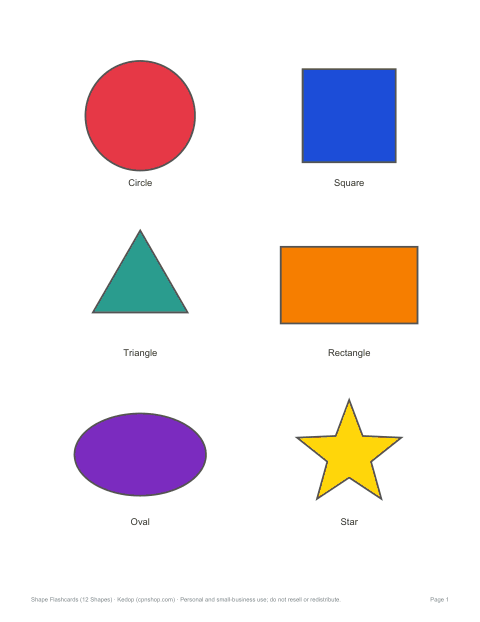
Clear, colourful shape flashcards for preschool and kindergarten. Twelve shapes are shown large and filled in bright colours with the name underneath, from circle and square to hexagon and trapezoid. Fact cards list sides and corners, and the pack includes outline matching cards and a shape hunt.
- Instant download
- Editable Word & Excel
- Print-ready PDF
- 7-day refund
5 files · PDF, DOCX, XLSX
Shape Flashcards (12 Shapes)
Colour shape flashcards for 12 shapes, outline matching cards, sides and corners cards, a shape hunt sheet and editable name cards.
- Colour shape cards (PDF)
- Outline matching cards (PDF)
- Sides and corners (PDF, DOCX)
- + 2 more
$5.00 USD, one-time 5 files · about $1.00 each
- Instant download
- 7-day refund
- Secure checkout by Stripe
7-day money-back guarantee. Full refund within 7 days of purchase, even after you download.
Free sample: Colour Shape Cards (PDF, 44 KB)
Shape Flashcards (12 Shapes)
Colour shape flashcards for 12 shapes, outline matching cards, sides and corners cards, a shape hunt sheet and editable name cards.
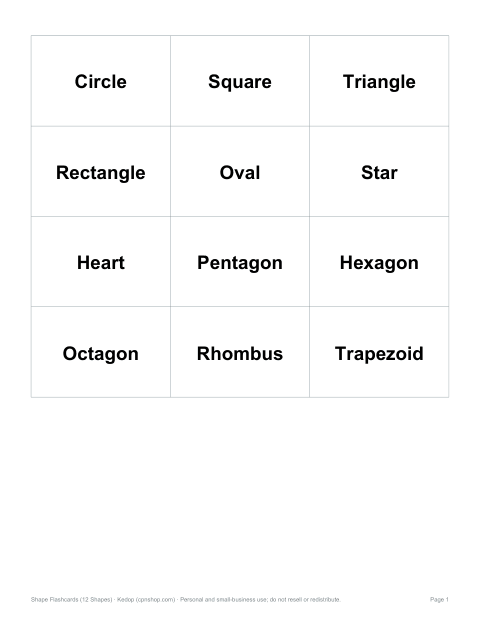
- Colour shape cards (PDF)
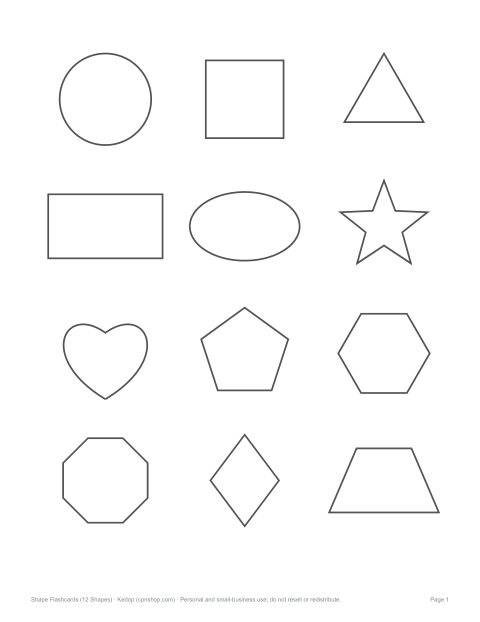
- Outline matching cards (PDF)
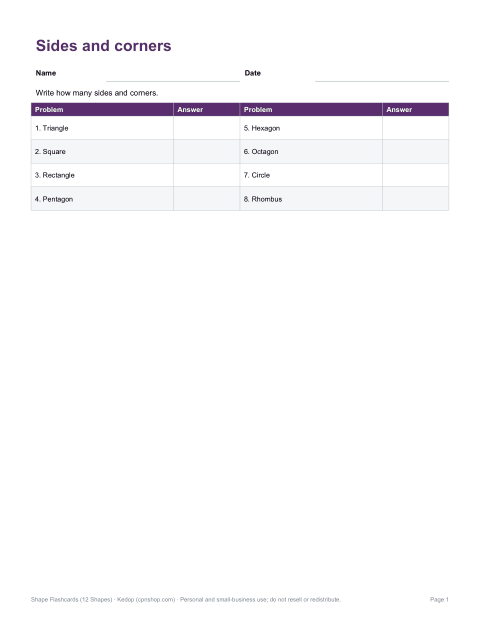
- Sides and corners (PDF, DOCX)
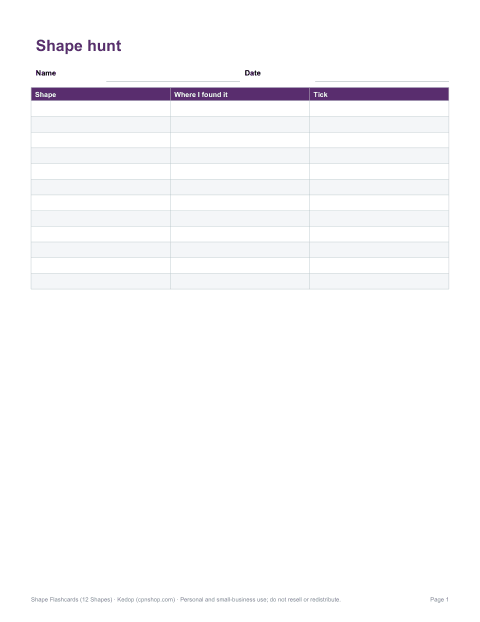
- Shape hunt (PDF, DOCX, XLSX)
- Editable name cards (DOCX)
Formats: PDF, DOCX, XLSX. Instant download after payment (link valid 72 hours, up to 5 downloads). AI-assisted: the templates were drafted with AI help and reviewed and laid out before publishing.
$5.00 USD, one-time 5 files · about $1.00 each
- Instant download
- 7-day refund
- Secure checkout by Stripe
7-day money-back guarantee. Full refund within 7 days of purchase, even after you download.
Free sample: Colour Shape Cards (PDF, 44 KB)
Full refund within 7 days — see the refund policy and license.
Free printables
Single sheets you can print right now, no sign-up. The full pack adds every sheet in one download plus the editable files.
 Printable Colour Shape Cards
 Printable Shape Matching Cards
 Sides and Corners Worksheet
 Printable Shape Hunt Sheet
 Editable Name Cards Printable
Shapes in the pack
Circle (0 sides, 0 corners), oval (0, 0), triangle (3, 3), square (4, 4), rectangle (4, 4), rhombus (4, 4), trapezoid (4, 4), pentagon (5, 5), hexagon (6, 6), octagon (8, 8), plus a star and a heart, which children love and recognise early even though they are not standard geometry shapes.
Why start with flashcards
Young children first recognise shapes as whole pictures — a door is a rectangle, a slice of pizza is a triangle. Flashcards give a clear, consistent example of each shape and its name, and colour helps them stand out. As children grow, the focus shifts from “what does it look like?” to “what makes it that shape?” — counting sides and corners, noticing that a square is a special rectangle, and recognising shapes turned at different angles.
Card sets
- Colour shape cards — filled shapes with names, six per page.
- Outline matching cards — the same shapes as outlines for pairs and matching games.
- Sides and corners cards — count and record the properties.
- Shape hunt sheet — find shapes around the home or classroom.
- Editable name cards — for other languages or new shapes.
Games with shape cards
Shape match — pair each colour card with its outline card. Shape detective — show a card and find something in the room with that shape. Feel and guess — put wooden shapes in a bag, feel one and find its card. Build it — make the shape with sticks, straws or play dough. Turn it around — hold a card upside down or sideways: is it still a triangle? (Yes!)
Talking about shapes
- Use precise words: side, corner (or vertex), straight, curved.
- Show different examples: long thin triangles and wide ones, not only the classic equilateral triangle.
- Compare: “A square and a rectangle both have four sides and four corners. What is different?”
- Connect to real objects: clock (circle), window (square), stop sign (octagon), honeycomb (hexagon).
- Ask children to explain how they know: “It has three straight sides, so it is a triangle.”
Who it is for
Parents, preschool and kindergarten teachers, homeschoolers, tutors and early years practitioners. The cards also support maths vocabulary for English language learners.
Formats
Print-ready PDF cards (US Letter; print on A4) and an editable Word name card file. Print colour cards in colour on card stock and laminate for heavy use.
Shapes and early maths
Shape knowledge is an early step towards geometry, and it connects to other skills: counting sides practises number, sorting shapes by properties practises classification, and building shapes develops spatial reasoning. Many early learning standards expect children to name common two-dimensional shapes regardless of size or orientation by the end of kindergarten, and to begin describing them by sides and corners.
Shapes around the house
Everyday objects make the best shape lessons: plates and clocks are circles, books and doors are rectangles, crackers can be squares, road signs show triangles and octagons, and a bathroom tile or honeycomb may show hexagons. After a flashcard session, go on a shape walk and take photos of shapes you find; printing the photos next to the matching cards makes a lovely classroom display or scrapbook page.
Printing tips
Print the colour cards and the outline cards on the same card stock so pairs feel the same in matching games. Cut with a paper trimmer for straight edges, round the corners with scissors for small hands, and store each set in a labelled envelope or zip bag.
Frequently asked questions
What shapes should preschoolers learn first?
Circle, square, triangle and rectangle, then oval, star, heart and others.
How many sides does a hexagon have?
Six sides and six corners.
Is a square a rectangle?
Yes, a square is a special rectangle with four equal sides.
Are the cards in colour?
Yes, the shapes are filled with bright colours; outline versions are included too.
Was AI used to create the cards?
The shapes were drawn by script and the text drafted with AI assistance, then reviewed before publishing.